Production
How pieces are made
The main body is 3D printed in quartz sand. Raw sand takes in water; pieces that meet water are sealed in post-processing. Colour is an appearance finish. We coordinate quartz sand 3D printing, post-processing, colour, packing and export documents. One contact from quotation to delivery.
Lead time
2–4 weeks
Maximum size
1800 × 1000 × 700 mm
How quartz sand 3D printing works
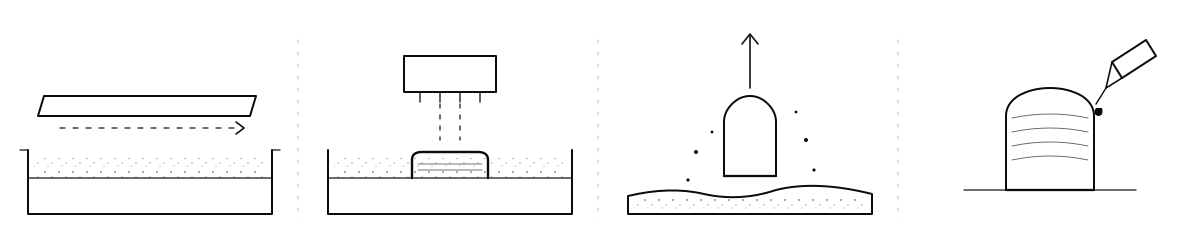
Also called binder jetting. Loose quartz sand supports the piece while it prints, so no support structures, moulds or tooling are needed. Undercuts, hollows and internal channels come out of the printer with the body.
1
Spread
A thin layer of quartz sand is laid flat across the build box.
2
A head lays down binder only where the body exists. The surrounding quartz sand stays loose and supports the form.
3
Lift and clear
The piece is lifted out and the loose quartz sand is brushed away.
4
Finish and colour
Pieces that meet water are sealed in post-processing. Colour is an appearance finish.
Material
The main body is 3D printed in quartz sand.
The sequence
The same steps for every piece.
01
Post-processing
Raw quartz sand takes in water. Pieces that will meet water are sealed in post-processing; a sealed surface beads water and wipes clean. Watertightness is not guaranteed unless stated on the product page. No liner is supplied.
02
Colour
Colour is an appearance finish: black by default, or to a colour card number you supply.
Material and care
- The body is quartz sand. The printed surface keeps the fine grain of the sand.
- Raw quartz sand takes in water. Pieces that will meet water are sealed in post-processing with a specialist adhesive; a sealed surface beads water and wipes clean. Watertightness is not guaranteed unless stated on the product page. No liner is supplied.
- Colour is an appearance finish: black by default, or to a colour card number you supply.
- Dust with a soft, dry cloth or brush. For marks, wipe with a cloth slightly dampened with water, then dry at once.
- No solvents, abrasives, bleach or polishes. Never soak a piece.
- Do not cut, drill or sand a piece. Quartz dust is harmful to breathe.
- Not intended for food contact. Lift by the body, never by a protruding part; felt pads protect the surface beneath.
Files and design rules
For bespoke work we check walls, fragile and loose parts, openings that let loose quartz sand out, units and scale, before anything is printed.
- Files
- STEP, OBJ or STL. Paste a link in the quote form; the form does not upload files.
- Walls
- 5 mm or thicker. Thinner walls are reviewed case by case.
- Overhangs
- 7 mm thick, out to 50 mm without support.
- Holes and hollows
- Holes from 3 mm. A closed hollow needs two openings of at least 30 mm so the loose quartz sand can be cleared.
- Corners and detail
- 3 mm fillets on inside corners; raised or cut-in detail from 1 mm.
- File checks
- Overlapping shells are merged; parts that touch nothing are found at review. Units, scale and mesh resolution are confirmed before printing.
- Built-in details
- Joints, sockets and lids are drawn into the file, not added later.
These are review starting points, not guarantees. Anything borderline is discussed at file review, before printing. Dimensions and finish are confirmed per order.
Bespoke →One confirmation
Nothing is produced until the digital proof is approved. Production then follows the approved proof.
New pieces and production notes
Occasional notes on new pieces and the process. A few emails a year, nothing else.
No spam. Unsubscribe in one click.